Monday, November 30, 2009

Duelling with Dr C


By ROD SMITH

Dr C and I had so much fun the first time that we climbed together in the Wolgan Valley – the highlight being the four-pitch jamfest of Cactus (18) – that we decided to do it again.

So on Saturday morning I lobbed into the Capertee campsite at 7.30am after six hours’ sleep at the Shady Acres Norman Bates Memorial Hotel in Lithgow. Dr Carl was already there, finishing off his breakfast, having lobbed in from Mittagong the night before.

After a quick gear sort we were off on our email pre-planned mission – climb Secret Swinger (16) on Lower Baldy to access the half-way ledge and then climb Scimitar (18) on Upper Baldy.

A straw poll of some climbing buds prior to the trip had put Scimitar marginally ahead in the preferred route stakes over Excalibur (17). But as it turned out Carl and I managed to do both Scimitar and Excalibur, presented as we were with perfect weather.

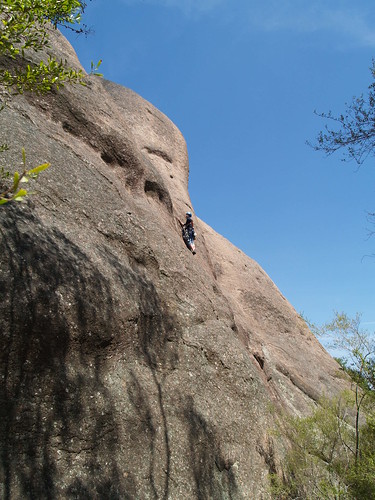
For those who aren’t familiar with Upper Baldy, Scimitar is the right-hand crackline up the soaring 100m face while Excalibur is the middle crack and crazy old Sword of Damocles (still 16M5) is the left-hand route.

It was my fourth trip up pitches 1 and 2 of Secret Swinger– a classic 50m right-facing corner – so Carl led the crux pitch. I led the second and then linked it with the little 10m third pitch that tops out on the half-way ledge. (The third pitch – a small crack – is actually a ripper, making Secret Swinger even more of a must-do Lower Baldy route).

On the half-way ledge we ambled up the base of Scimitar. Standing at the bottom the radical fore-shortening of perspective made the route look less daunting than it is when viewed from the campsite. The rock revealed itself as heavily featured sandstone with lots of ironstone edges.

We decided to make the four-pitch Scimitar into a two-pitch route. The first pitch wanders up a diagonal crack to small cave and a bit of an overhang. A well-protected, grunty move gets you over the bulge – on perfect jams and positive edges – followed by some steep climbing to a comfy belay in a sentry box.

Carl then followed up with two equally sterling grade 17 pitches which were sustained and well protected. We completed the route in under three hours and were back on the deck before 3pm, after rapping the face using the two ring-bolted Stiletto rap stations. (And despite being a stinking hot day we were in shade for the entire climb due to Old Baldy being a south-facing crag).

Mid-abseil down Old Baldy we were amazed to see another party on Scimitar. I talked to the bloke who'd just led the first two pitches. He "confessed" – unprompted – to being a sport climber and told me not to look at his gear placements. I suppose that Carl and I were quite baddie traddie-looking being hirsute and helmeted. His girlfriend - trailing a second rope – appeared to be complaining rather than climbing the face.

On Sunday the great weather continued but with the temperature feeling abut 10 degrees cooler. Dr C was so enthusiastic about doing another excursion up Old Baldy to do Excalibur that I immediately dumped the lazy monkey off my back and began to excitedly rack up.

To access the half-way ledge this time we decided to climb The Chain (8) to avoid the hot sun on the other routes and to avoid climbing Secret Swinger again.

All I can say about The Chain is it’s standard old-school, low-graded weirdness or "funky" as Carl described it. It's probably about grade 14 and contains more sand and leaves than rock on the first of its four pitches. Carl led the first three pitches and I thrutched up the final exit chimney pitch to the half-way ledge .

At the base of Excalibur things felt a bit more serious than the previous day. Even from the ground the rotten rock of the first pitch and the roof exit from the cave at the start of the second looked harder than Scimitar, despite Excalibur being graded 17 to Scimitar’s 18.

I decided to lead pitches 1 and 2 of Excalibur (17) as a single pitch to save time.

Wade Steven's Wolgan guide calls the second pitch 16 of Excalibur and pitches four and five as grade 17 equal cruxes. My response to that is bullsh*t! The second pitch roof move is as hard or harder than the other two crux pitches on Excalibur. The Penney/Taylor Wolgan guide lists Excalibur's pitches 2, 4, 5 as equal crux pitches which is correct.

In fact Excalibur as a complete route feels as hard as Scimitar and I reckon should be regarded as an 18. I think the roof move on Excalibur is harder than that on Scimitar - Carl agrees - but the whole route still has a grade 18 feel. Similar sentiments were expressed by half a dozen people I’ve spoken to before and after the climb.

After the combined first pitch Carl and I swung leads. I think my semi-hanging belay was a couple of metres lower than the "small stance" above the roof as per the guidebook. As a result Carl certainly had a long pitch on the grade 15 pitch 3 (as per guide) where the crack goes diagonally right to a small right-facing corner.

Pitch 4 (as per the guide) was a beauty. Once again with my arse was hanging out in the air - as it was on the first crux – I surmounted a cruxy bulge followed by some steep climbing to the stance.

Pitch 5 (as per the guide) gave Carl something to think about as he worked out how to get past the crux bulge. He succeeded after a couple of downclimbs (no weighting of the rope). Being on second I decided to launch up it head-on: a bouldery deadpoint dispensed with it easily enough.

We celebrated on top and gabbled excitedly about how brilliant both routes were.
Then we again rapped down Stiletto and were eating a late lunch on the halfway ledge at 4pm.

To summarise: Scimitar at 18 feels much less intense - with one crux and comfy belays - than Excalibur at 17 which we think is actually an 18 with possibly three grade 18 crux pitches and small belay stances, including a hanging belay.

Gear on both climbs is impeccable. With a fall rack of Friends and three extra Camalots plus four hexes and big nuts there was not one section of either route that felt runout or unprotected.

Four routes, no falls and perfect weather and two cold bottles of beer in the river waiting for us before the drive home! All in all a brilliant weekend.

PICS:

PICS: A few here with the routes marked and one of a bloke rapping down the face: http://www.flickr.com/photos/proseyr/tags/baldy/

Bunny Bucket Buttress: Rebolted

By ROD SMITH

Following Claw’s decision to entirely re-bolt Bunny Bucket Buttress and replace all the carrots with U-bolts, Jimbo and I decided it was time to climb this consumer classic.

Despite reports of horror runouts and recommendations that we carry a trad rack to supplement the bolts, we decided that we were too old and lazy to carry so much gear.

Mike’s post re-bolting recommendation was 16 draws, a cordelette and long slings. So we took 16 draws, three of which were extendables: In Law We Trust.

After a liquid breakfast of Get Up and Go we got up and went, leaving the lower campsite at Pierce’s Pass at 7am. After some leisurely mucking around at the Mirrorball rap – shiny new rings replacing maltreated tree – we were at the base of BBB (270m, 18) for a 9am kick-off.

The U-bolts were readily apparent as were the carrots that were still in place beside them. And that’s how the rest of the route was to be. Claw’s effectively created a DBB belay for most clips with a carrot beside or close to a U-bolt. He also seems to have added a few U-bolts.

The net result is an incredibly safe and fun route that is only marred by the combined 70m grade 8 pitches 4 and 5. But in saying that, both of these low-grade pitches are on rock rather than the bushwalks that most Blueys linking pitches seem to be.

Anyhow, at the risk of giving away beta, here is how the trip went.

Pitch 1: (18, 20m) The bouldery start gives way to easier climbing and a nice top out ledge.

Pitch 2: (18, 20m) Slabby start to a fused cornered followed by a rock over to an arête. Jimbo led this one and missed the belay on a comfy ledge and ended up creating a semi-hanging belay on the third u-bolt/carrot combination placement of the slabby start of pitch 3.

Pitch 3: (18, 40m) (Or 34m thanks to the off-route Jimbo) Up slab, across well-protected by quite delicate traverse then up well-bolted arête to top-out on big ledge and new DBB (rings) closer to the top-out than the original carrots which are more to the left (if you're facing out from the cliff).

Pitch 4: (8, 30m) Jimbo wander off up the slabs and then kept going until he ran out of rope. So this pitch was effectively 60m which includes a small overhang.

Pitch 5: (8, 40m) I only led the remaining 10m of this pitch which went up a rubbly wall to the foot of a big orange overhand and the TBB for the start of pitch 6.

Pitch 6: (17, 20m) Up wall out short overhang up headwall to big belay ledge. Jimbo led this bit. I seconded it but left the ‘draws in place so that two speedsters – CitationX and mate – could scream past us, using our draws, and get ahead of us. (I was amazed at their speed. They were still rapping down the Weaselburger rap – the three-pitch alternative to the two pitch Mirrorball rap – when we had just begun pitch 4! Shows you what two blokes on a single rope – hence the Weaselburger rap – and knowledge of the route – Steve had climbed it before – can do.)

Pitch 7 and 8: (18, 40m) Claw reckons that if you string pitch 7 and 8 together the single 2 x 17 pitches go at 18. Maybe. Each pitch up this towering, slightly overhung, headwall has a technical start for the grade but after that wherever you place a hand is a jug. Unless you get too gripped and start overgripping then the actual climbing feels like 16! However it is a long pitch and I can see how it would be good to retain the two pitches.

Pitch 9: (13, 40m) After gorging myself on the jug-fest before it, I felt a bit guilty when Jimbo had to lead the uninspiring final pitch – 20m rising traverse ending in juggy, chossy wall. Ah well, next time Jimbo.

Pics here: http://www.flickr.com/photos/proseyr/sets/72157622644940496/

Monday, April 13, 2009

Like chalk and choss

DVD REVIEW

By ROD SMITH

The British revel in eccentricity and nowhere has this been allowed full rein than in the sport that to outsiders appears completely dotty, namely climbing.

For evidence of this think of everyone from George Mallory and Andrew Irvine plodding up Mount Everest in their tweeds, to Don Whillans smoking cigars at high altitude, to stubbornly refusing to allow gritstone and bolts to co-exist, thus creating the sport of roped soloing.

Nowhere has the spirit of British climbing been better captured on films than on the new film Hard XS (Slackjaw Films).

From the team that created the legendary Hard Grit comes this crop of 10 short climbing films, each featuring on a different aspect of the game.

There includes the more familiar aspects of climbing including the understated and talented Steve McClure working and red-pointing his lengthy project Overshadow 9a (approximately grade 35) at Malham Cove.

It also includes youngster James Pearson describing his ascents of run-out gritstone routes like Knocking on Heaven’s Door and The Zone, both E9 6c or roughly 32/33 and Gaz Parry hanging off the ceiling of some dreary cave in Llandudno to create a series of 8a/8a+ routes (roughly grade 30).

But the real fun lies in watching the weirdness.


The first of these is the sheer terror on the second’s face as an ice axe-wielding Dave Thomas leads a quaking Martin Perry up a crumbling North Devon seacliff route called Breakaway HXS 5c/5b/5c/5a (about 18-21).

Perry: “It’s wrong”.

Thomas: “It’s a tottering pile of shale. You can’t get any decent protection in, the belays are shot to pieces. It’s how you cope with the journey which is the really interesting part”.

Perry: “I’m speechless to be honest. It’s rubbish, we shouldn’t be climbing on it”.

Four pitches later and the irrepressible Thomas is on top smiling as the blood slowly returns to Perry’s wan face.

Perry: “I’ve never been so stressed seconding”.


No less terrifying to the viewer, and at least one of the climbers, is Ian Parnell
and Chris Cubitt’s ascent of Great White Fright HXS (19/20) on the white cliffs of Dover.

Using ice axes and crampons the pair ascend the multi-pitch route in contrasting states of anxiety.

Parnell comments that “there are going to be moments when you’re going to have to
give yourself a talking to” and “who’s sane any way, who’s normal”.

Cubitt, who seemingly unwisely chose to do the route while on the road to mental recovery after a climbing accident, admits “I’m quite frightened now”.

When he tops out he’s more emphatic: “I did it on top-rope and I was fucking scared”.
Later Parnell returns in another short when he decides to again push his luck, this time tackling a long-standing unclimbed line in the Cairngorms when it is covered in two foot of ice.

Elsewhere there’s more dry-tooling madness when another pair launch themselves up another crumbling seacliff. We later hear that the route “fell down”.

There’s also the trickiness of climbing on slate in abandoned Welsh quarries, Neil Gresham indulging in the relatively sane sport of DWS and a funny and scary insight into one of Britain’s most successful mountaineers Andy Kirkpatrick in the tellingly entitled documentary Suffering Andy.

On being scared

By Rod Smith

The scariest lead that I can remember was about five years ago and it was my first trad lead after eight years away from climbing.

The pair of us rocked up to Secret Swinger (16) at the Wolgan and I was given the first pitch which, after an awkward start, is cruisy and well protected. I wobbled my way up and with great relief downed the rack in the sandy apocalyptic cave that is the belay.

After finding some attached sandstone amid the sand and blocks, I built an anchor and brought the other bloke up. When he got there he announced that he wasn’t interested in doing the second pitch and I’d have to.

Despite my protests I found myself climbing out under a roof, over a small rooflet and into a flaring corner. Nervous as hell I dropped three of the guy’s larger Camalots – he racked them in threes on one ‘biner which I hate – and watched as they hit the deck.

After stitching the first few metres with my remaining gear, I found myself horribly lacking in gear for the rest of the flaring corner crack and simply had to run it out for the last four or so metres to the top.

Feeling frightened and alone and buffeted by a stiff breeze that increased my feeling of isolation, I tentatively made my way upwards. I remember screaming gibberish, my mouth feeling like sandpaper as I wished I was somewhere else.

I also remember random, ridiculous thoughts like reassuring myself that my handjams would not involuntarily spring open like a boiled clam, that my harness buckle was still doubled back and that the knot wasn't untying of its own accord.

I also remember glimpsing my tent back at the Capertee campsite and wishing I was down there with a beer watching someone else doing this...

Then I mentally slapped myself and returned to the situation at hand which demanded that I shut the hell up and continue climbing...

After I eventually topped out and tied myself into a bomber nut I sat for a little while. I felt exhausted, and then the endorphins kicked in and I was exhilarated.

I’ve since been back twice since and led what it now a demystified climb. It's a familiar and friendly route but the chemical hit after I climb it never as good as that first time around.

Friday, March 06, 2009

Lost in a sea of bolts


By Rod Smith

It seems a funny thing to go all the way to Tassie – home of the brutal crack and bastion of trad climbing – to clip bolts.

Rick Fielding and I hadn’t intended it to be that way. But after a day at Ben Lomond, and on the way to more trad climbing at Freycinet, en route to the East Coast via the Lake Leake Highway the sign to Lost Falls beckoned us.

After three summer trips to Tassie in as many years we both knew that Lost Falls contained two 96m slab routes. Sport climbs, they sit side by side on the pleasant dolerite slabs that become the Lost Falls in winter and after heavy rain.

At 8am on a perfect summer morning we geared up in the car park before making the literally 5-minute walk to the triple rings at the top of the falls.

Well-bolted, the climbs are broken into three pitches, with each having independent first and second pitches before sharing the final easy pitch. Both climbs share three triple-ring belays/rap points.

After some arduous and unsuccessful attempts to prevent our double ropes falling into the remnant pools created by the trickle of water that is Lost Falls in summer, I set off with damp ropes up the first pitch of the first route, Ride the Dragon (15).

Despite looking slippery, the rock provided good friction, even the bits that were covered in dried, black slime. I was quickly at the top of the first pitch.

Rick led the champagne second pitch, the crux. At 50m in length and on the grade, it was a pleasant excursion even on second. Although slabby, the rock holds enough small fissures to render it easier to climb than say the granite slabs at Tarana, near Lithgow.

The third pitch was more of a formality than anything before we were once again tossing our ropes in every pool we could find, abseiling down to climb the next route, Black Dawg.

Black Dawg’s crux is its second pitch which is graded at 19. This time the champagne pitch went my way as we climbed the harder liner closest to where the waterfall develops after rain.

Delicate rockover moves and plenty of toeing and palming nuances in the slab made for absorbing and technical climbing. Seventeen draws were needed to complete the 50m second pitch.

Rick and I both agreed that the grade of the crux pitch was probably more in the hard 17/easy 18 range – or it may have been the euphoria of spending a few hours climbing a couple of four-star routes in the calming surroundings of the Tasmanian bush that made it seem easier.

Tragic history of climbing’s lost boys


Book Review

By Rod Smith

In the 1970s and ‘80s Britain lost some of its best mountaineers at an alarming rate.

This was no mass death caused by the sky collapsing, or too many people getting caught out in bad weather on overcrowded routes.

To the contrary these men – and they were all men – were climbers who were pushing the boundaries of alpinism, using techniques developed in the European Alps to climb the monster peaks of the Himalayan and the Karakoram.

Rouse, Clough, Haston, Estcourt, Boardman, Tasker are the familiar names among the dead whose lives are charted by Clint Willis in his book The Boys of Everest (Portico, London).

Subtitled Chris Bonington and the Tragedy of Climbing’s Greatest Generation, the book is a thick volume that attempts to draw together the disparate characters who climbed with Bonington on his many expeditions.

All of these stories have been told before, many by Sir Chris himself. Indeed much of the source material that Willis draws on is from well-known expedition books by the likes of Haston, Boardman, Tasker and Haston.

However, the strength of this volume is that it is a potted history of British climbing triumph and tragedy from Bonington and Hamish MacInnes on the Bonatti Pillar in 1958 to the deaths of Tasker and Boardman on Everest in 1982 and Bonington finally climbing Everest in 1985 at age 50.

Over 536 pages – complete with an index – the story unfolds as a type of combined formal history and adventure novel.

Willis’s ability to condense the factual side of the story and at the same time combine it with a novelist’s sense of storytelling highlights what a fine writer he is.

Like a novelist, he ascribes motivations and emotions to each of the key characters. For instance as the all-seeing narrator Willis tells us what Bonington thinks about a certain team member or why Douglal Haston and Don Whillans worked as a team despite Haston not caring much for Whillans as a human being.

Such information has been gleaned from interviews Willis conducted researching the book and it is woven into the characters of these real-life dramas, making the climbers human rather than one-dimensional heroic and tragic figures.

But if this style is Willis’ strength it could also be seen as his weakness: At times his writing moves from living history to pure fiction such as when the unknowable thoughts of dying climbers’ are described in purplish prose.

Thus when Willis tells us what Peter Boardman was thinking as he and Joe Tasker died on the Northeast Ridge of Everest the thrilling history is replaced by wild invention.

This would seem to be the domain of the pure fiction writer, not the practitioner of new journalism.

What we do know is that Boardman’s body was found 10 years after he died and that, to date, Tasker’s has never been found. The knowledge of that is poignant enough.

Thursday, November 06, 2008

This guide’s a cracker

As one of the true believers and a Tasmanian living in Sydney, I couldn’t part with my hard-earned cash fast enough when I heard that a definitive Ben Lomond guide was in the works.

In December last year Gerry Narkowicz announced that he and Bob McMahon intended to produce the definitive guide to what is arguably Australia’s finest crack-climbing destination, the Ben Lomond plateau, near Launceston, in Northern Tasmania.

Advance purchases were called for to help bankroll the project. A handful of people answered the call, including myself and the Sydney Rock Climbing Club, which contributed $2000 to the project from the guidebook fund.

Over a year later – on November 3 – MEMORY OF A JOURNEY: Rock Climbing on Ben Lomond (Climb Tasmania Incorporated) finally arrived in my mailbox.

It was well worth the wait.

Like past works by the McMahon/Narkowicz combination, this is a thorough guide to one of Tassie's great climbing areas. In this case it’s the soaring dolerite cliffs of the Ben.

The book is well illustrated with photo-topos and inspirational pics of climbing - yes, including of the guide book’s two authors.

This last point has been used in the past as a criticism of the duo’s guides, quite harshly I think. Unlike many “mainland” crags, Tassie crags are not usually swarming with climbers – save perhaps Coles Bay and sections of Mt Wellington. This is also true of Ben Lomond, which means that there is going to be a shortage of quality pics, unless they’re taken by and of the authors who’ve spent more time there than just about anyone.

Consider this: McMahon was on the first ascent team of 221 of Ben Lomond’s 350 routes and Narkowicz contributed 75 routes.

For the mainlander (such as I now am) there is a helpful list of "immortals" or the best climbs at each grade at every Ben Lomond crag.

There is also a handy precis of climbs and their grades at each individual crag and a three-star grading system.

The book also has a lot of non-guide book stuff and includes an evocative and highly entertaining section – chiefly by Bob McMahon - about the people behind the development of Ben Lomond’s individual climbing areas.

McMahon’s writing style is engaging and conversational. Even the deliberately stream-of-consciousness Who Did the First Climb on Ben Lomond? is a lot of fun, albeit an exhausting read, but then it is subtitled Stumbling on the Threshold of Memory.

Elsewhere McMahon paints with words:

“Full of delight, I want to say, this blue sky, these rocks, this mountainside, this stream, this dead twig, this white lichen, this yellow lichen, this black lichen – but there is no end to it, this naming of things in an effort to make the present graspable, complete, to exclude from one’s existence past and future, nostalgia or desire. And one may get stuck in the past by trying to hold onto the present. That’s the paradox. The present is continual, unfolding, despite the illusion of stasis one comes across on crystal mornings”.

And then there are the images of all those glorious soaring cracklines which are a sort of poetry in themselves...

- ROD SMITH

Thursday, October 02, 2008

Tick, tick ...


IF you’re going to the Sydney Rockclimbing Club's Wolgan Valley Sheep Roast and Reunion on October 25 and 26 you’ll need something to climb. Here’s a Wolgan tick list for bumblies of modest abilities but with buckets of enthusiasm ... just like ROD SMITH .

This tick list is based on numerous visits to the mighty Wolgan. All visits have started in a similar fashion – lofty plans to climb the classic multi-pitch routes on the towering Upper Baldy Cliff.

However, for some reason, whether it’s a hangover, heat/cold/wind or the coward-reflex response from repeated viewings of Upper Baldy’s lofty scariness, the climbing has ended up on the lower heights.

This is not to be denigrated, however, the following grab bag of climbs have yielded immense amounts of fun. All should be read with reference to Wade Stevens’ Wolgan bible Wolgan Valley Selected Climbing Areas.

Coke Ovens Cliff Lower

The Wars of the Roses (16) (P1 only) 22m. An excellent trad outing. Corner crack to slab. Rap off. BYO tat.

Organ Grinder (14) (P1 only) 27m. A stunning line up a big offwidth, but with plenty of gear inside the crack.

Deathbed Confessions (13) 60m. Two-pitches. Gear and bolts. Well protected. Same rap as DTB.

Dan the Bulldog (17) 60m. Two excellent pitches. Some consider the first run out. Bolts and gear.

Grunter (16) 51m. Two excellent pitches of trad corner climbing.

Sap (15) (P1 only) 27m. A trad pleasure. Rap off tree.

Coal Mines Cliff

Absolutely Sweet Marie (14) 53 m. Some whinge about it because it has a jamBing start. It’s a classic.

Monitor Madness (18) 50m. One of the most beautiful arêtes anywhere. Plenty of bolts but it also needs some gear.

Conspiracy (16) 45m. A brilliant line. Do the first pitch only for a 35m fest of well-protected offwidth. It’s like a grown-up’s Cave Climb at Narrow Neck.

Hellzapoppin (17) 45m. Brilliant. One long pitch. Bolts and gear.

Old Baldy Lower

The Pulpit (8) 39m. Old school. Safe enough despite climbs around this grade usually being horror shows.


Secret Swinger (16) (P1 and P2 only) 45m. Pure trad. I’ve done it three times ... BYO rap slings.

Room to Move (16) (P1 only) 45m. Tough start then pure jam crack. Heathens layback it. BYO rap slings.

Zoro’s Toaster (17) 70m. Sport climb.

Zarathustra (15) (P1 only) 40m. Lovely trad corner.

Tuesday, May 13, 2008

At the Barber shop


By Rod Smith

In 1973 Henry Barber amazed the climbing world when he free-soloed the 1000ft Steck-Salathe route on the towering granite of El Capitan.

Late last year, 34 years later, Henry Barber placed three pieces of gear while leading the 15m-high sandstone route Crack of Dawn at Sydney’s modest suburban Barrenjoey crag.

For a star-struck bumbly like myself, it was a jarring contrast between the “Hot” Henry whose legendary first visit to Australian in 1975 revolutionised free climbing and the now 54-year-old legend who was gleefully leading such an unimportant route.

As he carefully made his way up the modest crack and slab I wondered if Barber remained relevant in a climbing world now splintered into distinct disciplines and obsessed by number grades he could never aspire to.

Here in Australia to deliver a “greatest hits” slideshow of his climbing life, as much as to visit the life-long friends he’d made in 1975 and his last visit in 2000, Henry showed – during that all-too short day together – that he is the spirit of climbing and when we he speaks we should all listen.

Q: Why did you come to Australia in 1975?

A; “I came here really to hook up with Rick White and Keith Bell. I did the Nose (of El Capitan) with Keith Bell in 1973 but I climbed more with Rick White.
“When I came here I knew four things:
I knew about the Blue Mountains;
I knew about Frog (Buttress);
I knew about Frenchman’s Cap;
I knew about Ball’s Pyramid.”

Q: Just how frenetic was that visit?

A: “In 1975 I climbed 41 of the 42 days that I was here. I climbed in six of the eight (sic) States, in 27 areas on 100 routes. Of those routes 67 to 72 were first ascents or first free ascents.”

Q: So when did the local climbers start to take notice?

A: “After climbing Integral Crack (20) at Booroomba we went off and we did (the FFA) of Soolaimon 22. When I did Soolaimon I wasn’t sure that anyone would be able to follow me. I only put in two or three pieces of gear in all the way to the roof.
“That was kind of the start of the big blow-up attention to my style.
“I was climbing on a very small 9mm rope and I had a very light rack. My rack today is the same as it was 30 years ago.
“That’s kind of what started the chatter.”

Q: Of all the climbs that you did in Australia in 1975, which was the most memorable?

A: “Manic Depressive (24) (Grampians), even though I failed to climb it, that was my proudest moment.
“I had to put the little wires on the bolt studs. After a time I fell. I pulled the rope. I was climbing with Matt Taylor and he was jumaring with me and I thought this is not right.
“There’s a thing called the brotherhood of the rope. I thought, is this about having a day out with your mates or is this about me knocking off two harder grades?
“I thought I’d already done a 24 (Insomnia) at Frog Buttress although that’s since been downgraded.”

Q: What is it about climbing that has kept you motivated and doing it for 40 years?

A: “I’ve always been enthused. The short answer is that I’m a sick puppy.
“When I sink my teeth into something nothing can stop me. I have a few other passions but nothing has ever held me like climbing.
“I’ve never really drifted away from climbing. To me drifting away means climbing only 70 or 80 days a year. Now I’m climbing about 120 days a year.
“Climbing is really about struggle. If you don’t really embrace the struggle what the hell are you doing it for? It’s soul destroying. It’s soulless.
“Why I love climbing so much: you’re not entitled, it’s not a sure thing.
“That’s why I came to Australia, that’s why I climbed on grit in Britain, that’s why I climbed without shoes in Dresden (Germany).
“If you don’t focus on why you climb you’ll be seen more, if you do focus on (what you want to get out of climbing) you’ll be seen less.
“I was looking more and more to applying the mental side to climbing.”

Q: What was your work-rate like at the height of your climbing powers?

A: “Well I was working a sales rep for Chouinard but my climbing lifestyle was like that of a professional climber: I was climbing 320-350 days a year, the other 15 days were breaks or Christmas holidays.”

Q: What is your climbing philosophy?

A: “Do what you want, want what you do.
“By that I mean there are certain kinds of people who want to be on a really scary climb in a really scary storm and a scary situation. Then there are certain people who don’t: they get there and they don’t want to be there.
“I think a lot of people do stuff (like climb) because it’s a trend or it’s in vogue or they want to get to the top of the climb or if it’s business they want to be the CEO
“They’re all the wrong reasons.
“Between 1953 and 2006 there were 500 people who climbed Everest. (In 2007) 500 people climbed it in one year alone. It is special anymore just because it’s the highest mountain?”


Q: You have always been known for you clean-climbing, ground-up, trad ethics. What was it like for you during the 1980s sport-climbing boom?

A: “I was really depressed. The climbs looked spectacular and everything … so and so flashed 5.12 or 24 yet I was doing 5.12b barefoot years earlier.
“I didn’t think (US sport climbers) were making any headway - compared with gritstone or the climbing in Dresden- until the grades got to around 27.
“I thought it was bullshit and climbers were being expedient with their routes and not leaving things for future generations.
“So from 1980-87 I worked my ass off (with my business) and got my shoulders fixed. They were both dislocating badly.
“Since the mid-90s I’ve been able to climb pretty much as I want.”
“When I turned 50 I climbed in 11 countries.’’

As we headed back to Sydney, I asked Barber if he’d ever met one of Australia’s legendary hard men, Bryden Allen.

Despite having climbed Allen’s Lieben (17) in the Warrumbungles – “That’s a big-feel climb. I wouldn’t say that was one of the easiest routes I did in Australia” – he’d never met the man.

I told Barber that an accident in recent years had left Bryden wheelchair-bound but that he was still a member of the Sydney Rockclimbing Club and regularly belayed climbers at the climbing gym.

“That’s the coolest thing that I’ve heard in years,’’ Barber said.
“That’s what I want to know. That gives me energy to go for another 40 years of climbing.”

Friday, April 04, 2008

Multi-pitch madness ... or Knocking on Stephen's door


By Rod Smith

It was near midnight when we knocked on the door of Stephen Brown's house at the foot of Mt Roland, in North-West Tasmania.

As buggered as we were from the long day, Rick Fielding and I were keen to share a celebratory drink with the bloke who'd put up the route we'd just been climbing for nine hours.

Shaking off sleep as he answered the door, Stephen ushered us inside, proffering beer and soft seats to collapse into.

As the beer, to quote Henry Lawson, made us feel the way you ought to feel without beer, we talked about the 350m route that Stephen and some mates had established just over 30 years before on Rysavy Ridge.

We’d introduced ourselves to him that morning on the way up the hill. Discussing the weather, which was cold and windy, Brown had concluded “You’re set like jelly,”. A comment that ensured that conditions that we considered possibly too cold, suddenly became ideal.

Brown said he’d been monitoring our progress through his binoculars.
"You didn't go the easy way, I'll tell you that,'' he said.
“I’ve been that way myself and it isn’t 11 or 12 or whatever grade they’ve given Rysavy.”

We knew that much. As Rick had grunted his way up the steep pitch 4 and I’d tip-toed my way up the delicate, cracked face of the 60m pitch 5, we were fully aware that we were technically off route.

The Rysavy Ridge route description is spare and simply says: “the climb is fairly straight forward, generally following the line of least resistance up the ridge … ”.

For the first three pitches we found that the line of least resistance meant keeping to the left.

ry10

Our decision to not keep left happened after we had a near-synchronised need to take a crap half-way through pitch 4. After we returned to the hastily discarded gear, from opposite ends of the big ledge, we examined where the next pitch went, and felt uninspired. Then we examined the wall to the right.

That pitch and the next, arguably, pumped the grade of the route to up around the grade 17+ mark but in doing so provided the best climbing of the day. At the time we even thought we might be onsighting some new variant pitches. It was not to be.

After “line of least resistance up the ridge” the rest of the Rysavy route description says: “ … unless you want to make your own, harder variation (which many have, sometimes inadvertently)”. Then Stephen confirmed he’d been there before.

We'd begun the route at 8.30am. Despite being early February and technically summer, it was cold and windy enough for us to climb in thermals and windshells. As I led up into the unknown, buffeted by the strong winds, I had a knot in my stomach: situation normal for me on multi-pitch routes.

I ran the first pitch out the full 60m of our double ropes – as we’d decided we would do where possible – before bringing Rick up.

Pitch 2 added a bit of spice as it wandered upwards to a head wall cracked by an off-width. I shivered as Rick made his way up through a fairly mixed pitch before tackling the short off-width. Settled on a big ledge, he quickly brought me to the top.

It was at this time that our friends John and Marian Shaw decided to call off their climb of the ridge. Starting behind us, Marian had led the first pitch only to slip on the damp lichen. Scraped and cold, the pair set up a windbreak and tried to warm up before deciding that retreat was the better part of valour.

Rick and I felt bad for the Shaws who were very keen to do the route. John, however, decided that there was still plenty to be done and for the next 10 hours acted as a sort of base camp, calling us up on our walkie-talkies and checking our progress. On the walk back to camp, he guided us down the twisting, ankle-breaking track which he’d re-marked, on the way up to meet us, with reflective tape.

But before we could be guided down we had to climb the thing...

Pitch 3 was broken into two: the first a short pitch to a corner in which I found a fixed wire (which I left). We then moved the belay around the corner on the left side of the ridge to an off-width corner.

After moving up the corner 10m I decided to strike out right onto a overhanging, juggy headwall. Why? I dunno. I blame it on reading three different accounts of the climb which included the words "juggy wall".

Freaked out by a hex that had someone levitated and followed me up the overhang – leaving me gear-free for a considerable way – I decided to head back to the crack. This decision included hanging off a precarious-looking flake with a pebble embedded in the top and ensured that I created one of my best ever Z-drag scenarios, despite the double ropes.

With some difficulty I topped out on a pinnacle in a comfy bower and brought up Rick. As it happened it was also the same place where the overhanging headwall would have topped out, had I stuck to the line.

Rick struck off on the fourth pitch, for about five minutes: that’s how long it took for him to gain the big, shrub-lined, aforementioned ledge where we downed tools for a synchronised bowel movement.

On the ledge were two, small wrist-sized or smaller shrubs with white slings around the bases. It appeared that someone had bailed from the ledge down into the ridge's descent gully. It's the same gully - after three hours of tangled-rope abseils off tiny trees and muddy bum-sliding in the darkness - that I would come to think of a small slice of hell lodged in the Tasmanian wilderness.

Back in character on the ledge – pants on, harnesses cinched – we examined the left-hand side of the ridge for the next part of pitch 4, only to be repelled by the sight of the scrubby corner.

Then the blunt, juggy looking arête on the right caught our eyes. I instantly thought: "It’s Rick’s lead, sucker". Then I thought: "A variant, a variant, ring the bells, let’s steal some history". Rick agreed with the second thought.

It seemed to take ages for him to climb the arête. When it was finally time for me to follow I soon discovered why. Sloping, vertical and not as hold-riddled as it looked, it was a tough pitch.

ry12

A rightwards traverse was all that was left between Rick and I, but it was on slopey ground with stuff-all gear and plenty of falling-into-the-abyss potential.

From a distance Rick looked to be seated in a comfy, corner belay. When I got there I found he was belayed in a bottomless corner with no room for me. I momentarily wished we’d taken the less-exciting option above poo ledge.

To begin pitch 5 required a tenuous tip-toe around Rick to gain the wall. That somehow achieved, I eyed the delicate flakes of rock that I were between me and a factor 2 fall. Possibly whimpering, I gingerly scaled the flake before slamming a skin-tearing fist-jam into the lovely crack above. Feeling more secure I looked up and up and up. The pitch appeared to be at least 60m. With our stripped down rack – for luggage weight reasons – I noted that I’d have to be a bit careful with gear.

Another guidebook phrase “delicate cracks” screamed at me as I negotiated the pitch which involved swapping from one crack to the next, ruthlessly ripping out with one hand a small bush, while barely holding on with the other, and banshee-like screaming of the word “below” after accidentally dropping a football-sized brain-bomb Rick’s way.

By the time I topped out there was little rope left and only three pieces with which to make a belay. I was exhilarated, or knackered, I can’t remember which.

Rick wandered up oblivious to the drama I’d undergone for the past hour, in much the same way as I suspect pitch 4 had been for him.

ry16


With gear swapped, Rick led off on pitch 6, stretching the rope out the full 60m amid a varied pitch of small buttresses, unprotected mini-overhangs, culminating on a three-point belay on a tiny tea-tree that was clinging miserably to the rock.

Pitch 7 was a long, easy and scrappy affair. It began nicely enough, with another near vertical wall whose cracks provided secure gear placements. After a short portage to the next belay, I brought Rick up to defeat the rope drag. Then I continued the route up a short chimney, before again bringing up Rick. Still calling it pitch 7, I led on up a scrubby ridge just shy of the climb’s highpoint: once again rope drag had dictated the pitch length.

It was Rick’s good fortune to reach the highpoint before leading across the knife-blade ridge that connected our route to the rest of the mountain. With massive drops either side it was a spectacular pitch.

Pitch 9 was mine. After a wider section, the ridge once again returned to a cheval. As I traversed, I noticed just how late it was getting: 7pm by my scratched and nicked watch. This realisation suddenly made me cold and hungry. I stopped and made a belay. Just beyond the ridge narrowed even further: two maddeningly exposed rock steps with massive exposure either side before the ground widened and became the head of the descent gully. It was an easy decision. I radioed Rick: “Mate, I don’t want to do this bit, it’s your pitch”.

Youth came skipping along the ledge, barely stopping to rerack, before nonchalantly negotiating the narrow step and finishing the climb: a nice, even 10th pitch.

I quickly followed Rick and we wandered down to the descent gully. A microwave oven-sized chockstone, festooned with a motley rainbow collection of slings and cord, ominously marked the first abseil.

With darkness now falling I threw our doubles off the chockstone anchor into the even darker gully. Then I rapped off, all the while hoping that the chockstone wouldn’t beat me to the bottom. It held.

For the next three hours we battled darkness, tangled ropes and rap points that were mostly no more than collections of tiny trees lassoed together by tat, to abseil and slide by torchlight back to the base of the climb. From there our most excellent mate John guided us back to Stephen’s hearth.

Friday, January 11, 2008

Suburban cragging: Mt Alexandra.


In this first in an occasional series on suburban cragging around Sydney, ROD SMITH looks at a crag that is technically not even suburban…

If you’re tired of dodging the Saturday morning sport-mums convoy of people-movers and Toorak tractors (flash 4WDs), on your stop-light-ridden way to Barrenjoey or Narrabeen Slabs, then the Southern Highlands crag of Mt Alexandra is for you.

Instead of schlepping at a snail’s pace up the Wakehurst Parkway, or over Spit Bridge, you could be barrelling at 110 km/h down the M5, headed for the Southern Highlands town of Mittagong.

It’s here, just a little over 70 minutes’ drive from Sydney that you’ll find Mt Alexandra. Despite being about 100km from the CBD, or twice the distance as Barrenjoey, Narrabeen or Berowra, the travelling time to Mt Alex is as fast and often faster.

A largish north-facing crag, it is mostly comprised of sport climbs, with a few mixed and trad lines thrown in. www.thecrag.com lists more than 80 climbs while Peter Monks’ Sun, Surf and Sandstone online guide (www.sydneyclimbing.com) has descriptions for more than 70 routes.

The rock is sandstone, generally slabby in nature, with excellent friction. It’s a great crag to practice your footwork on as many of the moderate-grade climbs require some degree of smearing.

The grades range from 8 to 27 but it should be noted that some routes in the easiest grades are solo-only, non-protectable outings, which means death-route status for most of us.

Regardless of this, there are plenty of moderate grades and shiny bolts to satisfy the most demanding of climbers for quite a few visits.

Top of the tick list in the easy grades would be the traditional warm-up routes B (15), Open to Public Scrutiny (14) and In the Inn of the Sixth Happiness (13). Each of these climbs is located in the Central Area.

The nearby adjacent Vox Populi area has some good moderate-grade sport climbs including Dorothy the Dinosaur (17) Red Room (18), Vox Populi (18) and Mousetrap (19).

On a recent visited it was noted that this popular wall has also sprouted three more bolted routes, according to thecrag.com: Hugh Town (19), Vox Fox (16) and Silver Fox (20).

But the pick of this wall would have to be Dorothy the Dinosaur followed by the omninous-looking roofed Vox Populi ,which is really a jug-fest with the crux lower down and needing wires to protect it.

The attractive curving corner crack Michael in Shorts (16) also provides some sweaty good times, but would appear to be slightly undergraded, due to the hard move needed to gain the climb's sole bolt - after you’ve negotiated the crux.

For those climbers interested in some serious cranking, it should be noted that one of the developers of this crag has been Garth Miller. His routes include Ultine Demence (27) and The Big Day Out (24). But he also contributed the aforementioned Open to Public Scrutiny.

Other important features of the crag include its close proximity to two pubs and a bakery that serves good coffee. In case of rain it’s also close to the bookshops of Bowral.

Of course if you got to Bowral you’ll have plenty of Toorak tractors to avoid.

Wednesday, November 14, 2007

A giant climbs among us ...


"Hot" Henry Barber is visiting Australia at the moment, giving slide shows all over the country including Thursday, November 15, 2007, at the Bowler's Club in York St, Sydney. Tickets are $15.

The show is presented by the Sydney Rockclimbing Club and Mountain Equipment. Tickets are available at the door on the night.

Not sure who Henry is? Put it this way Rock and Ice magazine listed him among the 10 legends of the sport.

In 1975 Barber came to Australia and climbing was never the same again.

By the time “Hot” Henry he left six weeks later, he had climbed 29 cliffs in six different states and the Australian free climbing grade had been lifted to 23.

His ticks included the first free ascents of Cock Corner, 21, at Frog Buttress, and the Arapiles classics Kachoong, 21, Kama Sutra, 23, including his virtual solo of Thunder Crack, 20.

His first ascents included Insomia, 22, at Frog Buttress, Reaper, 22 at Mt Arapiles and Daedalus, 20, on Hobart’s the Organ Pipes.

More than 30 years later and Henry is still living the climbing life.

Tuesday, October 30, 2007

The Endless (K)not

Hey, WAKE UP!

Has everyone gone SOFT and taken up GOLF?

What happened to the HEADY MIX of CLIMBING and GIBBERISH with which we used to block one another's emails.

The STABBING fingers on MAPS and in GUIDEBOOKS in pubs on tables AWASH with BEER.

Where are those PLANS for EPIC CLIMBS and days of BEER and BULLSHIT?

All the BIG days that we PLANNED for, during those mean, little days of work and winter.

This time last year we were EXCITED and CRAZY.

We were TRAINING and PLANNING and TRAINING and TALKING about an OBJECTIVE: A BIG SCARY, DREAM OF AN ADVENTURE.

Now we're quiet and absent and not climbing much and selling stuff and child-rearing and busy and busy and busy and melting away ....

Now there is silence -------------------------------------------- on the line.

Where has all the LOVE gone?

I had EXISTENTIAL ANGST but thankfully the ENNUI has kicked in.

Friday, October 05, 2007

Routes less travelled


DVD REVIEW: First Ascent (Sender Films)

By ROD SMITH

The quality of US director Peter Mortimer’s last climbing film was such that it virtually was the travelling 2005 Banff Film Festival.

Who could forget the beauty of Indian Creek as showcased in Parallelojams or the cuteness of the climbing Jack Russell dogs?

As a result the expectations for Mortimer’s new film First Ascent (Sender Films) were high. And so far repeated viewings of this 95-minute world-spanning feature have fulfilled those expectations.

With its self-explanatory title, the film sets out to document a variety of wild and impressive new routes.

They include the terrifying trad zone of Colorado’s crumbling Black Canyon – including the aftermath of a massive leader fall – as showcased by Jared Ogden and Topher Donahue.

Then there’s Swiss crack ace Didier Berthod’s amazing effort on “Europe’s hardest crack” Greenspit, as well as his determined efforts on the Canadian supercrack the Cobra. In the case of the latter it is one of the few non-first ascent, with Didier beaten to the ascent through a combination of injury and the equally determined efforts of the Canadian climber Sonnie Trotter.

The best of the bunch, however, would have to include the manic energy of Cedar Wright and Ivo Ninov as they work their project Cosa Nostra. Entitled The Obscurist, this part of the film might be set in Yosemite, but as the title indicates it’s about Wright and Ninov working an obscure line. This is not about a new towering, multi-pitch route, but a grunty, maddening roof crack. Gnarly stuff, dude.

For elegance and sheer daring the best of the lot is Dean Potter’s attempt on The Tombstone. This thin, long and strenuous dihedral in Moab, Utah showcases Potter’s superlative climbing style and his willingness to fall long distances on small gear. He even eschews the protection of large cam – and so is forced to run out the top of the climb – to help ensure he makes the first free ascent.

Less necessary, but certainly fashionable and entertaining, is the section on German wunderkind climber David Lama and his pals deepwater-soloing in Thailand and taking some big falls.

For Timmy O’Neill fans the weird, hairy guy is back this time soloing buildings in LA and trying to sell the concept as a TV show called Urban Ape to a bunch of bemused producer types.

Overall there’s enough climbing here to keep anyone satisfied. The camera work is, as always, superb and the soundtrack will have you seeking out the tunes that accompany the visuals.

Monday, September 17, 2007

The call of the wild

By Rod Smith

AS a new climber I want to know if I have to sell my car so that I can be like all the other climbers that I hang around with.

None of them have transport which I put down to their heightened sense of environmental awareness, especially when we go to wilderness crags like Earlwood, Berowra and the Sydney Harbour Bridge pylons.

Having six climbers hanging out of my Datsun 200B is not 100 per cent safe for humans – although many wear their Petzl brain buckets on the way – but it certainly is better for the environment.

I’m willing to sell my car for a number 10 hex.

While it will be inconvenient not having a car it will also lessen the embarrassment of being the only climber I know who owns a car and knows how to drive an automatic transmission.

With no car I can clear my head of all the mechanical knowledge I have and replace it with important climbing learning, like how to sling a chickenhead and why it’s better to thruch up a grade 8 death chimney with no protection than lead a bolted grade 14.

What I hope is that lots more bumblies appear on the horizon to take up the slack in the system by letting me bum a ride.

The only real disadvantage I can see in not having a car is the safety factor. My last emergency-climbing epic was at the climbing gym when I was benighted on a green climb.

Luckily I had the car and next morning could drive to the nearest McDonald's for breakfast. If I'd had to catch a bus I would surely have died on the spot from starvation.

After I sell my car I plan to make two more important changes so that I am a more environmentally conscious climber like my friends.

1. Never offer to buy a shout at the bar.

2. Get together with three others and buy a coffee and then sit around it for two hours.

Now that I read back those two aims look more economically conscious. Maybe I’ll stop buying deodorant, which is both economically and environmentally conscious.

By the way my name is Billy and I have been climbing for five minutes.

I've already put up six routes - four of them are unclaimed staircase climbs; one was the monkey bars at my old primary school and the other was the first recorded ascent of a ladder on a bunk bed display in the Ikea shop.

I’m on the lookout for climbing partners. Beginners are OK, especially if they own transport, like a Vespa or a pair of rollerblades.

Thursday, August 02, 2007

Overheard imagination ...

Are you a god Christopher? I am. I feel it every hour that I’m out here. When we’re so far from the soup, doing this, caught up in it, I imagine it’s how God feels.

It takes me two days to get over this. Every Monday I am in a black hole. I feel the ordinariness of it all. The quotidian shitfight that I’m supposed to live for the next 40 years.

The tie and collar existence, the dinner on a lap, too tired to fuck or frolic miasma.

That’s why you can’t die on me cobber. This stuff is ours. It’s what we do together. Our enthusiasm is equal. Our dedication would shame so-called athletes. Our bravery is worth a Victoria Cross. I am afraid of nothing except the situations in which we put ourselves every week and we do that for fun. It defines me.

What we are is not back in Sydney, it does not live in the moments that we are with the girls.

What I am is here, now. It is the 12 hours on a Saturday, the three hours at the gym once or twice a week and the minutes and hours that I surf the net or read books that feed this obsession.

My identity, my very life has become indivisible from you, the rock, the wilderness, the aluminium, the nylon, the adrenalin, the fear. The fear.

Friday, May 04, 2007

Hell and high water

By Rod Smith

It was the most twisted of nightmares.

It began with my shouted name. Ripped into wakefulness, I felt the tent floor moving, like some sort of beast, beneath my sleeping bag.

I couldn’t focus my eyes and a rushing sound filled my ears. A light came on and a stern face appeared.

I tried to put on my eyeglasses but they crumbled, broken in my hand. I found my contact lenses and they went on as if guided by an unseen hand.

My sight restored, I poked my head outside and began yelling. In seconds, monsters with glowing mono-eyes were grunting and bellowing, stuffing huge sacks as a black river rose around their legs.

The reality was simpler.

In the stygian darkness of a Tasmanian pre-dawn, on January 28, 2007, the South Cracroft River had flash-flooded and our campsite was fast disappearing under water.

What had begun as well-planned expedition to climb Federation Peak in South-West Tasmania was ending in a fury of tannin-coloured waters, as one and then three of our four tents were flooded.

Once carefully packed rucksacks now became mere containers for the desperate cramming of sodden gear, as the river continued to rise around our legs.

When Brian and Luke Richardson’s tent literally ended up under water, it became apparent that our trip had ended less than 24 hours after it had begun.

Six months of training walks, self-rescue sessions and long traditional climbing routes in the Blue Mountains had been included as part of the mental and physical preparation for our ascent of Australia’s highest cliff.

Six-hundred metres and 20 pitches of climbing up to Ewbank grade 18 was to be our reward for two days of carrying 30kg-plus packs.

We had chosen to access the remote South-West Tasmanian peak via the shortest route possible, the notorious Farmhouse Creek Track.
start
That was the plan. Unfortunately the Tasmanian summer had other plans.

When we disembarked from the rented people-carrier at the trackhead, it was raining.

As we posed for a group photograph the sun came out briefly, before once again being swallowed by the clouds. Apart from few feeble rays over the next few hours, that was the last of the sun.

On that first day we had planned to cover 18km and sleep at Cutting Camp before pushing on to Bechervaise Plateau, via the short and nasty Moss Ridge. From Bechervaise the climbing teams – Gus Davidson and I, Rick Fielding and John Shaw – would push onto Blade Ridge and in a two-day push link it with the North-West Face Route.

As it transpired, by near sundown on the first day we’d covered just 9km and found ourselves on the banks of the rising South Cracroft River.

Our progress had been slowed by a combination of our massive packs and the exhausting effort of having to negotiate dozens of massive, slippery, fallen trees that choke the Farmhouse Creek track.

With little choice, we bunked down for the night, feeling positive that the next day would be better. While the river was rising, checks later in the night indicated that it had slowed.

It was not until 5.30am – about two hours after the last level check – that Gus’s shout of my name, and the feeling of our tent floating, revealed that the river had broken its banks.

For the next two hours the eight of us worked in a frenzy to rescue our gear from the rising waters. When the madness ended it was 7.30am. At least two of the team had saturated sleeping bags, while three of the tents had been soaked inside and out.
startI had no intention of being forced into a position where we would have to activate the EPIRBs that NSW electronics company GME had loaned us for the trip.

With no sign of the weather abating and the knowledge that the track in front of us followed the now raging floodplain for at least another 9km, the decision was regretfully made to abandon the trip.

For the first hour we waded through waist-high waters: the muddy buttongrass plains had become a river. With the track gone, the Garmin GPS units – again courtesy of GME – proved invaluable, as we followed the electronic breadcrumb trail back through the now flooded maze of thick scrub.

Nine hours after we had fled the South Cracroft River we were back at the car park where we had started. With no phone coverage and no scheduled pick-up for almost a week, we set up our sodden tents in the equally sodden car park, prepared for a long wait.

Then luck found us: Some rafters happened upon us and agreed to take one of our members – Simon Kearney – back to Hobart. The following morning Simon arrived with the rented bus and my worried parents in tow. In a few hours we were back in Hobart.

Determined to get some climbing in on this, so far, climbing-free trip, I proposed that we head for the granite cliffs of Coles Bay on Tasmania’s East Coast. Within a few hours six of us had downgraded our transport to a heavily laden Tarago and we were bound for the coast.

Luke and Brian elected to stay behind and make a tourist flight around Federation Peak. As it turned out, the weather in the South-West stayed rotten for three days. Scenic flights were grounded by 100km winds around the Federation Peak area, forcing Brian and Luke to return home to NSW.

Meanwhile, John, Rick, Gus, Simon, Jim Dickins and myself – along with John’s wife Marian and Marian’s dad Wizz – enjoyed four near-perfect East Coast days.

I hadn’t climbed in the area since the early ’90s but armed with the brand new Climb Tasmania guide and the older Craglets guide we picked out some classic easy lines.

We revelled in the warm, bombproof and high-friction granite trad routes. Among my highlights were beautiful crack climbs such as Cordon Bleu (15), on Lassie’s Wall and Slaughterhouse Five (16) on Whitewater Wall. Equally pleasant was the RP-protected corner Ice Nine (16) and several low-grade rambles up the 50m-high Whitewater Wall.
start
Perched high above the surging Southern Ocean, we used yet another GME product - UHF two-way radios - to communicate on the multi-pitch routes on the pleasant Whitewater Wall. For Team Pom - Rick and John - the opportunity to use the well-practised routines they had planned to use on Federation was not to be missed.

For Team Slackarse - Gus and I - it was a case of high quality cragging.

Whatever style was used, the climbing teams found that the East Coast days went a long way toward erasing the memory of our abortive Federation trip. It's hard to beat days on warm rock, bookended by bakery breakfasts and pub climbing post-mortems.

This erasure process continues, such that, among some members, there sounds to be the low rumblings of once more organising a trip to Federation Peak.

If and when they do come knocking, I hope that I’m not home.

Thursday, February 15, 2007

Last hurrah at Tarana


By Rod Smith

Five metres above my last bolt, frying in the sun, working out how not to peel off what appears to be the crux moves and all the while feeling electrified rather than terrified by the situation: Welcome to Tarana.

A small band of us decided to head to Tarana (aka Evan’s Crown Nature Reserve) to beat the expected National Parks and Wildlife Service ban on climbing that the Sydney Rockies – through the efforts of access officer Kevin Westren – have been trying to head off.

This geological anomaly of giant granite tors, about 25 km from Lithgow, has been climbed on since the 1970s, its popularity waxing and waning on a regular cycle. It is a place of physical beauty, an important part of local Aboriginal culture but it is also a unique place to climb.

There is something undefinable about the area that makes it either a spooky or energising place to climb, depending on your perspective. On my third trip there, I had to keep reminding myself to climb rather than just sit amid the huge boulders, taking in the sheer beauty and otherworldliness of the area.

Impressed by Paul ‘Farty’ Turner’s bold lead of the classic Crown Buttress route Up The Nose of Love (16) I’d decided to give it a go myself. Three bolts in 35m is fairly run-out, even by Tarana’s infamous standards, but as with many climbs at Evan’s Crown Nature Reserve, once you’re there it all seems to make sense.

Gus and I had warmed up on other Crown Buttress classics including Jika Jika (17) and its companion climb Jailbreak from H-Block (17). After the varied steep slab of Up The Nose of Love (16) we wandered around and caught the evocatively named Blue Train (17).

Farty Paul, John ‘JB’ Shaw and Rick Fielding also visited Jika Jika and Jailbreak from H-Block before Team Pom – Rick and JB – decided to scrub bash their way up Passionate Pleasantries (13) on Googolplex crag.

At this point it’s worth pointing out that Farty, Rick and John were climbing as a trio because the Thrutch editor was a bit under the weather when we went to collect him on the morning of the trip.

After Passionate Pleasantries, which JB and Rick were neither passionate about nor did they think was pleasant, it was back to the quality routes on Crown Buttress.

With Farty Paul they climbed Your Neighbourhood Bolter (17) before linking it to Barry Dur for the top out. They then spent as much time jumping backwards and forth photographing each other negotiating the leap-off/walk-off as they did the actual climb.


Speaking of leaps, the highlight of the trip for me was watching Farty Paul come close to splitting in half as he bridged up Tanner’s Leap (13), the access climb to the very top of Evan’s Crown. Rick and JB followed.

Gus and I elected to not join the caravan. Instead we sat at the bottom of the crag and I photographed three weird-looking rock sprites waving at us from on high.

To those who have yet to visit Tarana the message is clear: GO NOW.

Route details can be found in the SRC publication Rockclimbs In the Upper Blue Mountains as well as Rock Magazine’s Pocket RockGUIDE, Evans Crown Tarana.

To read Kevin Westren’s excellent SRC submission to the NWPS about allowing climbing to continue at Tarana go here: www.sydneyrockies.org.au

Tarana pics here: http://www.flickr.com/photos/proseyr/tags/tarana/

Monday, November 20, 2006

Emu parade

By Rod Smith

Our first attempt to climb The Emu ended at a red backpack at the top of the cliff.

After frustrating hours spent getting lost and scrub-bashing along the indistinct trail to Kedumba Walls, the presence of another party on the 10-pitch adventure route spelled the end of our quest.

Annoyed, scratched and sleep-deprived we bowed to good judgement and decided that the four of us would end up climbing in the dark if we pushed on.

On that occasion we turned around and scrub-bashed back, in 30-degree temperatures, to the car and thence to the pub at Leura.

Savage with disappointment, we downed enough beers to unanimously vow never to go near The Emu again.

Yet here it was, just one month later and we – me, John Shaw, Rick Fielding and Gus Davidson – were once again standing at the top of this infamous adventure climb in the Blue Mountains near Sydney.

Our earlier trip had not been a waste. From the intelligence gained we reached the top of The Emu in just 45 minutes, compared with the two hours it had taken us the first time around.

There are two ways of accessing the climb. After reconnoitring the walkdown last time, we elected for the three-abseil option using our two sets of 60m double ropes to speed up the transitions.

After 90 minutes of abseiling and walking we reached the base of the climb. An old water bottle and various cairns mark the start.

There’s been a lot of stuff written about The Emu. Most significantly the uncomplimentary article in Rock magazine which makes the route sound like a death-trip.

There are also two route descriptions that vary significantly: Roger Bourne’s classy topo on the Boycetown website http://www.geocities.com/mountboyce/MainFrameSet.htm, with its detailed pitch descriptions and drawings, gives the route’s crux at 17.

The description in our own publication Rockclimbs in the Upper Blue Mountains calls the climb 15, with a 17 variant pitch.

From our point of view Roger’s information was on the money although Rockclimbs in the Upper Blue Mountains provides vital route-finding information.

The time was a bit after 11am as I led up the pleasant grade 14 slab corner/crack that is the first pitch. Gus quickly followed which allowed John and Rick to begin.

The second pitch was Gus’s and it required a short walk through a narrow chimney to the base of the cliff. This was followed by bridging up the tightish squeeze, using cams and nuts in the right-hand wall. After a slabby section, the pitch exits up an easy, unprotected, juggy orange wall near a cave.

Pitch 3, mine, was a bit scrappy with most of the protection being in the form of slings around a few small trees, followed by an unprotected haul onto a juggy slab behind a grasstree (blackboy).

The top out was on a small triangular stance with a dwarf apple gum, which Roger describes correctly as a “weak tree”.

I volunteered to also lead pitch 4 which is a slab corner that goes at either 14 or 16. For me this pitch felt like 16. The gear was also suspect: Gus was belayed into the weak tree and a 0 Friend while I tottered upwards, protected for the first half of the slab by a 00 Friend, a No. 2 RP and a No.1 Rock. After that there is no gear for the last 3m. A fall would have been nasty.

I believe pitch 4 is the same pitch on which first ascentionist Greg Mortimer (who put up the route with Lucas Trihey and John Ewbank in 1993) is pictured in Rock magazine.

The run-out to the top of the slab was followed by some nice climbing up a well-protected flake section before the top-out onto the treed ledge. Here we stopped for a 15-minute lunch break.

Gus scored pitch 5 which begins with a short climb up some blocks and then a traverse around a corner to an exposed position, looking onto massive walls of choss. We broke this pitch into two, with Gus leading both. The second part went up a shattered arête with good cams, into a sandy ledge which Gus gingerly traversed to the next tree belay. Roger notes that this part contains a “sickening void”.

I found pitch 6 quite enjoyable. It flows easily up a small orange wall then into a well-protected corner before exiting onto a gravelly ledge.

At grade 12, it felt easier than pitch 5 which is grade 11. After topping out on pitch 6 I wandered to the left and tied into some trees and welcome shade.

Pitch 7 starts directly above the tree belay. A steep bouldery start, it’s tough for a grade 14 which is why the small, dead tree at its base shows signs of being used as a de facto step ladder. Gus led this pitch which includes a tricky grovel through a backpack-grabbing tree onto a slab and up to a small ledge with a tree belay.

Pitch 8, the crux, was short and sharp. After setting off up the ferny left-wards groove I quickly found a nice cam on the left wall followed by a bomber hex in the corner. Some tricky stemming – which felt closer to grade 17 than 15 – was followed by another cam and a nut and a leftwards exit onto a ledge.

Wanting more crux I wandered leftwards along the ledge only to discover that that was the end of the pitch.

Gus followed up and quickly took off above my comfy two-cam belay to begin the grade 12 pitch 9. A well-protected chimney, it abruptly exits onto a scrubby she-oak (casuarina) ledge.

Rather than belay on the slippery slope scrub Gus bushwalked upwards, occasionally slinging trees, until he was close to the start of the final pitch.

Pitch 10 is a grade 5 or 8, depending on whose instructions you read. Really it was just an easy scramble upwards for 10m before the welcome sight of our backpacks.

Gus and I topped out at 5.55pm. John and Rick surfaced a bit over an hour later.

In the twilight we packed up. Half way out it was dark. With head torches on and John’s GME GPS providing vital route-finding corrections we found the car and from there we fled to the pub.

Over beers we vowed never to go near The Emu again…

Thursday, October 19, 2006

Operation: Wolgan

By Rod Smith

Voices in the dark: Many garbled voices from over the UHF radio, and a single one coming from somewhere up on Lower Baldy.

The radio voices were the excited, massed gabblings of those back at the campsite where day two of the SRC Wolgan Valley sheep roast weekend was in full, boozy swing.

The lone voice belonged to Mike Patterson who with his second had decided to spend the night on the half-way ledge of Lower Baldy.

With four beers onboard myself, I had joined Hamish Kerr and Roger Austin in a search for the missing duo after they failed to return from a day on the hill.

Standing in the ruined tennis court of the Wolgan Valley mine manager’s house, we yelled Mike’s name. Minutes later a calm voice answered back. Mike told us that he was on The Chain and due to a certain shortness of abseil rope and lack of head torches would be spending the night on the half-way ledge.

A quick check of the Wolgan Valley guidebook revealed that the claimed 50-odd metre height of The Chain was probably more like 80m if they were on the ledge.

Aware that Mike, in the spirit of the ’70s-tinged feel of the sheep roast weekend, was wearing nothing but a pair of jeans, a t-shirt and a massive handlebar moustache, it was decided that a rescue would be effected, regardless of his shouted intentions.

The plan fell together. Hamish announced that he would walk up to the half-way ledge and locate the missing. Roger and I decided to go to the base of The Chain, near Secret Swinger, retrieve packs, head torches and the all important shoes and meet up with Hamish on the walkdown descent of Solo Gully.

With every walkie-talkie in the valley tuned to channel 1, the whole operation had the surreal feel of a reality TV show. But the reality was that it was more a retrieval than a rescue.

At the base of Secret Swinger Roger and I were joined by Hugh Ward and Nigel Donnelly. With both ready to climb The Chain in the dark it was only a radio call over Hamish’s walkie-talkie that scuttled their night-time ascent: Hamish had located the missing pair.

By 11pm everyone was back in camp. Most headed for their sleeping bags while others reached for another beer.

Beer seemed to be a key ingredient of the first SRC Wolgan sheep roast in several years.

For roast organisers Luke Merritt and Hugh Ward it had fortified them from 8am on the Saturday morning when they began to dig the fire pit and assemble the spit.

It kept fortifying them throughout the day as they watched the two dressed lambs slowly roast while the rest of the camp went off and climbed rocks.

They were still quaffing strongly when it came to carving up the roast at 9pm and on into 1am when your correspondent called it quits and hit the sack.

Among those attending was SRC Life Member and veteran of countless roasts Russell Taylor who is also the custodian of the spit.

Amid dozens of families who’d fled to the Wolgan for the October long weekend, SRC members claimed a chunk of the Little Capertee Campsite that is unremarkable but for the fact that it inexplicably contains a rock with a red Nazi swastika painted on it.

The roast itself was superb: beautifully cooked meat served with tabouli and flatbread and consumed with joy by the light of dozens of head torches.

For most, Monday heralded a return to the city. For myself and Jim Dickins it meant another three days of climbing in faultless spring weather.

After a nine-week absence from climbing due to an injured hand, six days of climbing in the Wolgan seemed to me the perfect way to make up for some lost time.

Highlights included the classic The Pulpit on Lower Baldy, the very fine Decline and Fall on Lower Coke Ovens, the hot, sunny May Day Mayday at Petrie’s and the imposing Khe Sanh at the Lower Coal Mines.

With the SRC gang gone and the town hordes significantly diminished the largely absent wildlife returned to the campsite.

On our last night Jim and I sat with our dwindling beers, amazed at the sight of six wombats grazing almost side by side like sheep while up in the sky a huge ring appeared around the almost-full moon.